Nicolás Maduro’s Political Track Record in Venezuela
Written by Aidan Jarvis
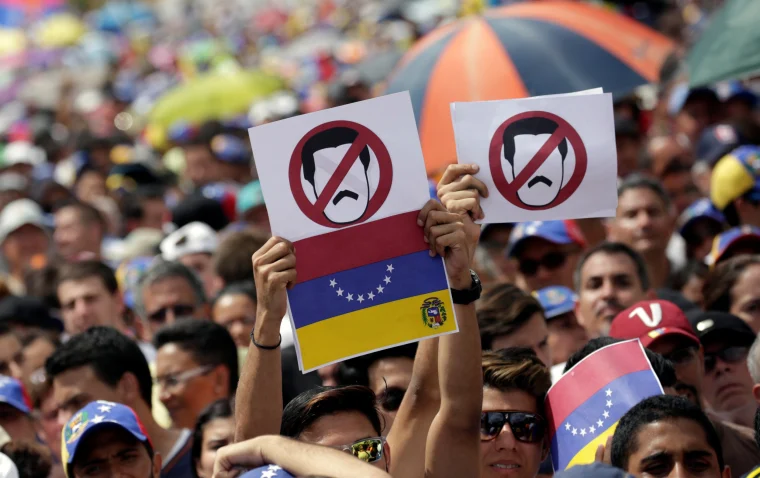
Nicolás Maduro’s rule over Venezuela has been underlined by political controversy and economic collapse. In 2013, Nicolás Maduro, the leader of Venezuela’s socialist PSUV party, was elected President despite allegations of election fraud. In 2017, amid economic hyperinflation and political unrest, Maduro proposed a new council capable of revising the national constitution and securing Maduro power over the elected National Assembly. According to the New York Times, a poll conducted by the opposition taken by over 7 million Venezuelans showed that 98% were disapproving of Maduro’s actions. Ensuing anti-government protests, as well as an unsuccessful coup staged by National Assembly member Juan Guaidó, were met by security forces. 29 Venezuelans died during this brief chaos, per the New York Times. In the end, Maduro successfully created the National Constituent Assembly, or ANC, in an act condemned by many nations as a ploy to avoid further elections and consolidate power. However, the 2017 Venezuelan Constitutional Crisis would not be the only plight of his reign.
In 2019, Maduro was reelected for a second 6-year term, with the National Assembly again claiming election fraud. On January 10 of 2019, The National Assembly denounced Maduro’s victory as illegitimate, and insisted that Juan Guaidó was the real president. The US along with many nations in South America and Europe formally recognised Guaidó as the acting president. However, Maduro was able to retain military support and was therefore able to stay in power. This national schism became known as the 2019 Venezuelan Presidential Crisis. Currently, the United States endorses Maduro’s former Vice President Delcy Rodríguez as the legitimate leader of the country.
However striking Venezuela’s political predicament was under Maduro, it pales in comparison to the economic failures of his administration. Of countries not experiencing war or terrorism, Venezuela has had the largest economic collapse since 2013, according to the Economics Observatory. Maduro’s socialist policies of government interventionism in their rich oil industry led to what economists call a “mono-industry economy”. This means that the Venezuelan economy relied heavily on its oil exports, with no other enterprises being able to sustain the welfare of the country. It is important to note that China and Venezuela were active trade partners since Maduro came to power, with the BBC reporting that the two had over 600 trade agreements in place. On the evening of January 2 2026, mere hours before his capture by US forces, Maduro praised China and President Xi Jinping. Nonetheless, the once promising Venezuelan oil market could not save the failing socialist economy. According to the Economics Observatory, living standards in Venezuela have dropped by 74% under Maduro’s policies. This would make it the fifth largest economic skid since they began tracking data in 1990, and the single largest fall among peacetime nations. Maduro’s failures, both economic and political, left Venezuela in a state of division and decline.
Important details about Nicolás Maduro’s capture
Written by Jack Hewitt
Former president of Venezuela, Nicolás Maduro, was recently captured by the United States military and is now facing federal charges. Maduro was captured then flown into the United States on January 3rd 2026, he landed at Stewart Airport which is only an hour long drive from Rhinebeck. The former president is being charged with narco-terrorism conspiracy, cocaine importation conspiracy, and possession of illegal weapons. The case against Maduro includes Maduro allegedly working with Venezuelan gangs and cartels to import cocaine into the United States. 7 tons of cocaine directly linked to Maduro, 30 tons of cocaine linked to his associates, and possession of illegal weapons such as machine guns and grenades. Maduro has pleaded not guilty to all charges and referred to himself as a “kidnapped president” and a “prisoner of war” while leaving court on January 5th 2026. Maduro’s lawyer has argued that Maduro should have immunity because Maduro is the leader of a sovereign nation and was illegally taken by force into the United States to prosecute him. Prosecutors say Maduro corrupted once legitimate institutions and abused his power to import tons of cocaine into the United States. The next hearing for Maduro’s case is March 17 2026, until then Maduro will stay in Metropolitan Detention Center where figures such as Ghislaine Maxwell and Sean Combs have been previously, and is only two and a half hours away from Rhinebeck. Leading up to the capture of Maduro, the United States conducted at least 35 strikes on suspected Venezuelan drug boats. The first strike on one of these boats was on September 2nd 2025 and continued through at least December 31st 2025. These strikes caused at least 115 deaths, the strikes were mostly in international waters, 11 struck in the Caribbean sea, and 23 struck in the Eastern Pacific Ocean. In the end of 2025 the United States conducted its first known direct strike on a land target inside Venezuela, targeting a docking facility targeting alleged drug traffickers. These strikes were heavily controversial in that the strikes were seen as illegal in United States and international laws.
Venezuela’s response to the capture of Maduro
Written by Sammy Erdman
With the holiday season at an end, many are able to relieve the stress of gift giving and get-togethers and return to their normal lives. This is not the case for the people of Venezuela. On January 3rd,2026, the U.S. attacked and captured The Venezuelan President, Nicolas Maduro.
Venezuela’s future still remains unclear, with the U.S. President, Donald J. Trump’s announcements of the U.S. taking over and Venezuela’s Vice President, Deley Rodrigez currently acting as president of Venezuela. The constant back and forth has Venezuelan and American citizens frantically checking the news for updates on what comes next.
Pictures and videos of Venezuelans hugging, shouting, and crying in the streets of Venezuela surface the internet. According to news source, “‘The Conversation’ in an article titled, ‘Venezuelans are reacting to Maduro’s capture with anger, fear, hope and joy’ jubilant Anti-government chants flood the streets: y ya cayo, este gobierno ya cago or “it fell, it fell, this government fell” and se fue, se fue or “he’s gone, he’s gone”.
In the same article, a 26 year old delivery driver described how he partied until midnight hours, “I’m very happy” he said “They finally captured that dictator.”
It is not smooth sailing for everyone, though. Some fear the consequences of the U.S. taking over and have deep suspicions on Trump’s motives. “I am skeptical,” says Jaime, a resident of Caracas, “I don’t know if I should be happy because I don’t like Trump’s tone. He continues with his theory that we stole his oil and it sets a terrible precedent. Losing our sovereignty over the resource that sustains Venezuela would be something terrible.” (The Conversation)
Others fear what displaying their true emotion publicly could do to them and their families. Ernesto, a small business owner in the central city of Barquisimeto, described how his friends and neighbors are responding to Maduro’s arrest during an interview with BBC: “A lot of anticipation and uncertainty. There’s joy that Maduro has been taken away, but no one is celebrating in public. Lots of people won’t go out because they’re worried that they’ll be stopped and robbed of their car and money if they’re out on the street. Others have gone out to stock up on groceries and gas in case of shortages.”
Rumors of a possible outcome of war have Venezuelans not sure if they should be celebrating or crying “I know what war means” Araceli, a Venezuelan woman says on BBC news choking on her own tears “I can’t celebrate until I know my family are safe”